Grafting pair
excellent compatibilityMagness
on OHxF 87 rootstock
- Compatibility
- Excellent
- Tree size
- Semi Dwarf
- Mature height
- 12–15 ft
- Crop
- Pear
Compatibility and disease notes
OHxF 87 (Old Home x Farmingdale) carries strong fire-blight resistance, ideal for pear production in the humid eastern US.
Overview
Magness pear on OHxF 87 is a practical, well-matched combination for the humid eastern United States, where fire blight pressure makes rootstock selection consequential. OHxF 87 (Old Home x Farmingdale) carries strong resistance to Erwinia amylovora derived from both parent species, reducing the risk of rootstock loss even when the scion encounters infection. The resulting trees reach 12 to 15 feet, a manageable size for home orchardists and small commercial plantings that want reasonable picking height without sacrificing yield per acre.
Magness itself carries moderate fire blight resistance at the scion level, making this pairing particularly well-suited to the Northeast, Mid-Atlantic, and Southeast, where summer humidity sustains persistent blight conditions. Oregon State OHxF Rootstocks document the rootstock's consistently strong performance across humid growing regions in multi-year trials.
One planning note specific to Magness: it produces non-viable pollen and requires a compatible pollinator within 50 feet. Bartlett, Moonglow, and Bosc all work. Planting Magness without a pollinator produces no fruit regardless of how well the graft takes. In colder parts of the Northeast (zones 5 and 6), OHxF 87 has shown reliable winter hardiness, though growers pursuing high-density block plantings sometimes prefer the more dwarfing OHxF 333 for tighter spacing.
Best regions
Step-by-step grafting guide
Whip-and-tongue grafting is the standard approach for bench-grafting Magness onto OHxF 87 liners. The critical timing principle: scion wood must be fully dormant when the rootstock cambium is just beginning to activate. In the Mid-Atlantic and Southeast, this window typically falls late February to mid-March. In the Northeast, early to mid-March is more reliable. Grafting too early (both fully dormant) slows callus formation; grafting too late (scion already swelling) desiccates buds before the union closes.
Collect scion wood in late January or early February, before any bud swell begins. Select pencil-diameter shoots from the previous season's growth with tightly closed buds and no signs of blight canker or discoloration. Bundle in lightly damp paper, seal in a plastic bag, and refrigerate at 33 to 38 degrees Fahrenheit until grafting day.
Tools needed: a sharp grafting knife (a dull blade tears cambium and reduces union rates significantly), Parafilm or grafting tape, and grafting wax for sealing cut ends on larger-diameter wood.
Procedure: - Cut both scion and rootstock at matching 45-degree angles, approximately 1.5 to 2 inches long - Make the tongue cut: a second cut into each face starting about one-third from the tip, running parallel to the grain - Interlock the tongues so at least one side of the cambium layers aligns precisely - Wrap tightly with grafting tape from bottom to top, covering all exposed cut surfaces - Keep unions dry and shaded from direct sun for the first two weeks
Bud break on the scion within 4 to 6 weeks indicates a live union. If no buds push by week 8, the graft failed.
Common failure modes
Cambium misalignment accounts for the largest share of failed unions. Pear cambium is thin, and even slight lateral misalignment prevents callus from bridging the cut faces. The risk increases when scion and rootstock diameters differ significantly. Select liner stock that matches scion diameter closely, and confirm alignment on at least one side before wrapping.
Timing errors are the second common failure mode. Scion wood that has begun breaking dormancy before grafting pushes vegetative growth before the union is established, desiccating buds as the incomplete graft cannot supply water. This is more common when scion wood is collected too late or stored improperly (above 40 degrees Fahrenheit). Collect early, keep cold, and graft before the rootstock shows more than marginal cambium activity.
Fire blight at the union is a real risk during wet spring conditions, even with OHxF 87's strong rootstock resistance. The graft union itself and the Magness scion above it carry no special protection from the bacterium. Avoid grafting immediately before forecast rain events, and inspect unions weekly once temperatures consistently exceed 65 degrees Fahrenheit. Water-soaked discoloration at or just above the graft line requires prompt removal to prevent spread into the rootstock.
Sources
Frequently asked questions
- Is OHxF 87 a good choice for wet, humid climates?
Yes. OHxF 87 was specifically selected for fire blight resistance and performs well in the humid Northeast, Mid-Atlantic, and Southeast, where blight pressure is highest. It anchors well and tolerates heavier soils better than some older pear rootstocks.
- How big will a Magness tree on OHxF 87 get?
Expect 12 to 15 feet at maturity under normal orchard conditions. Spacing at 12 to 14 feet in the row and 18 to 20 feet between rows is typical. Pruning practices affect final height considerably; trees managed to an open-center form may stay closer to 12 feet.
- Why does Magness need a pollinator?
Magness produces sterile pollen and cannot fertilize its own flowers or those of nearby trees. A compatible pollen donor planted within 50 feet is required for fruit set. Bartlett, Moonglow, and Bosc are reliable pollinators that overlap bloom time with Magness in most regions.
- When is the best time to graft pear in the Southeast?
Late February to mid-March is the typical window in the Southeast, when scion wood remains dormant but rootstock cambium is beginning to activate. Actual timing shifts by a week or two depending on elevation and the specific year's winter pattern.
+−
+−
+−
+−
Related
Related grafts
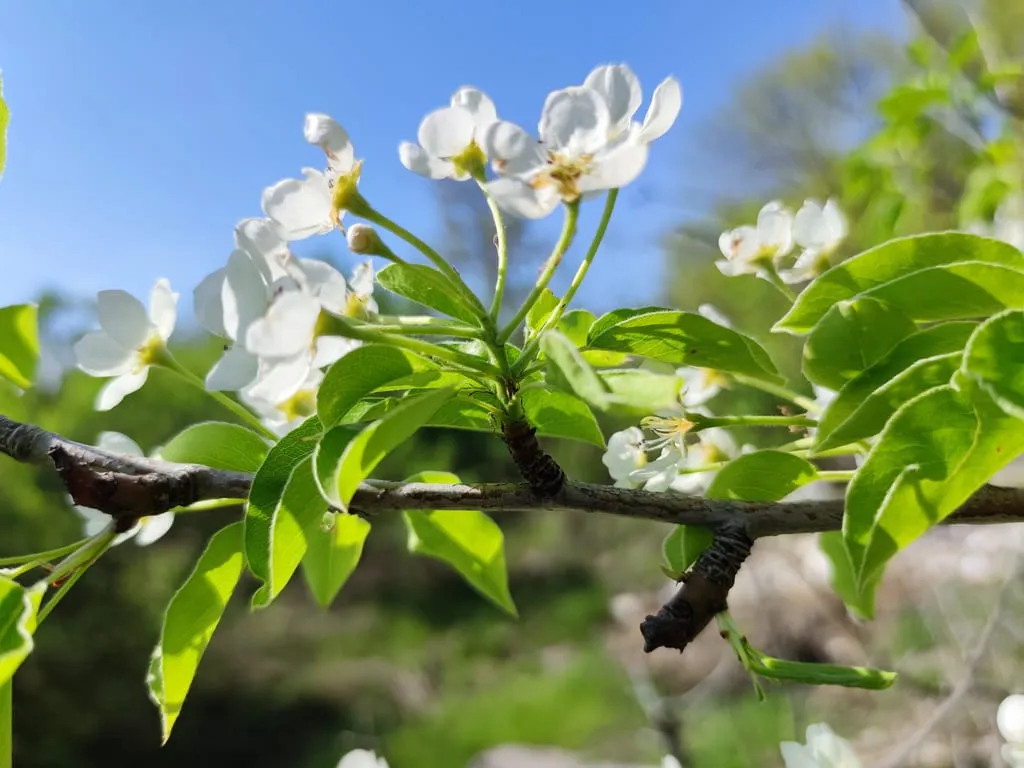
Image: "Груша обыкновенная", by Vasily Moryashkin, via iNaturalist, licensed under CC-BY. Source.