Grafting pair
excellent compatibilityHoneycrisp
on Geneva 41 rootstock
- Compatibility
- Excellent
- Tree size
- Dwarf
- Mature height
- 8–10 ft
- Crop
- Apple
Compatibility and disease notes
Geneva 41 offers fire-blight resistance, replant-disease tolerance, and excellent precocity. Honeycrisp on G.41 is the modern high-density orchard standard.
Overview
Honeycrisp on Geneva 41 is the modern high-density orchard standard. G.41 produces a true dwarf tree (8 to 10 feet) that bears in year 2, requires permanent trellis support, and packs roughly twice the production per acre as semi-dwarf systems. For backyard growers, the appeal is the small footprint and rapid production. For commercial growers, the appeal is the early payback and disease resistance.
G.41 carries fire-blight resistance, replant-disease tolerance, and excellent precocity. Combined with Honeycrisp's eating quality, it's hard to beat for serious home production. The only caveat is the trellis requirement; the rootstock has a relatively brittle graft union and trees can topple in wind without support. See the Cornell Geneva Rootstock Series for full performance data.
Best regions
Step-by-step grafting guide
G.41 grafts use the same whip-and-tongue technique as MM.111 but the timing window is narrower because dwarf rootstocks break dormancy earlier. Aim for mid-February in zone 7 and adjust for your climate.
- Collect scionwood in late December or January, store cold (32 to 40°F) wrapped in damp paper.
- At graft time, trim the rootstock at the desired bud-grafting height, typically 24 to 30 inches above ground for high-density planting.
- Cut both surfaces with a single smooth diagonal pass; precision matters more on dwarfing rootstocks because the union is the structural weak point for the tree's life.
- Match cambium layers on both sides if possible. Wrap with parafilm tightly.
- Install permanent trellis support before tree goes into ground. Trees on G.41 will need this within 18 months and retrofitting a trellis around an established tree is awkward.
Common failure modes
G.41 is more fragile than MM.111 at the graft union. A poorly executed graft, or one that experiences wind stress before fully healing, can snap years later. Use a clean sharp blade and take time matching surfaces.
Second, lack of trellis support. Trees lean and ultimately fail. Don't skip this step.
Third, overcrop in years 2 to 3. G.41 induces heavy fruiting early; if you don't thin aggressively, branches break or the tree exhausts itself. Hand-thin clusters to a single fruit per cluster in years 2 to 4.
Sources
Frequently asked questions
- Why does G.41 require a trellis?
G.41 produces a precocious dwarf tree with a relatively shallow root system and a brittle graft union. The trellis prevents the tree from leaning and ultimately failing under crop weight or wind.
+−
Related
Related grafts
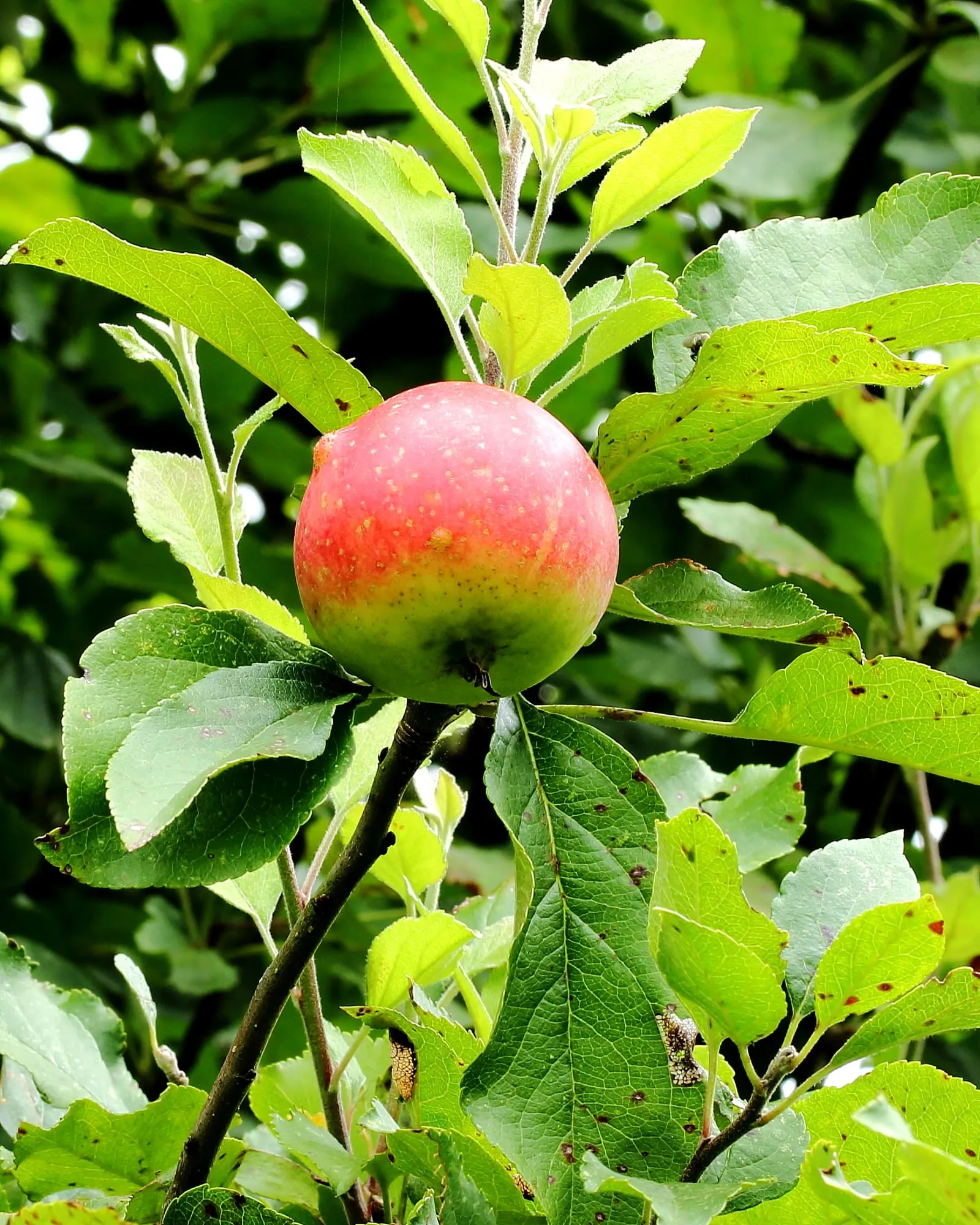
Image: "Malus domestica 'Stark's Earliest'. Locatie De Kruidhof 02", by Dominicus Johannes Bergsma, via Wikimedia Commons, licensed under CC-BY. Source.
