Grafting pair
good compatibilityEnterprise
on MM.106 rootstock
- Compatibility
- Good
- Tree size
- Semi Dwarf
- Mature height
- 12–15 ft
- Crop
- Apple
Compatibility and disease notes
MM.106 is productive but susceptible to crown rot in poorly drained sites. Enterprise's disease package compensates.
Overview
Enterprise on MM.106 is a semi-dwarf combination suited for home orchardists and small commercial growers in the Mid-Atlantic and Southeast who want a productive apple with strong disease resistance and a manageable tree size. Trees typically reach 12 to 15 feet at maturity, are reliably anchored without permanent staking on most sites, and enter bearing in year 3 to 4.
Enterprise, developed by the PRI cooperative, carries resistance to apple scab, cedar apple rust, powdery mildew, and fire blight. That disease package matters here because MM.106, while productive and precocious, is susceptible to crown rot caused by Phytophthora cactorum in poorly drained or waterlogged soils. Enterprise's foliar disease resistance compensates for the rootstock's vulnerability at ground level, but it does not protect against the soilborne pathogen itself. Site selection is therefore non-negotiable: this combination performs well on well-drained loam or gently sloping ground and poorly on heavy clay or low-lying spots that collect standing water.
The Cornell Apple Rootstock Guide includes MM.106 among the more productive semi-dwarf options with good anchorage characteristics. For growers in the Southeast and Mid-Atlantic managing moderate disease pressure, the combination offers a practical balance of tree size control and yield without requiring a high-spray program.
Best regions
Step-by-step grafting guide
Bench grafting onto dormant MM.106 rootstock whips is the standard approach. Whip-and-tongue is the preferred technique for this crop because MM.106 liners at graft-union height typically run 3/8 to 5/8 inch in diameter, matching well with first-year Enterprise scion wood of similar caliper.
Timing: Graft in late winter, from late January through mid-March, before either the scion or rootstock breaks dormancy. The window closes once the rootstock shows active growth. Collect Enterprise scion wood in late December or January while fully dormant; shoots from the current season's growth with 3 to 5 plump buds per stick are ideal. Store scion wrapped in slightly damp paper towels inside a sealed plastic bag at 34 to 38 degrees Fahrenheit. Use within 8 weeks of cutting.
Tools: A sharp grafting knife is the single most critical variable. A dull blade drags and compresses the cambium rather than cutting cleanly. Have grafting tape or budding rubber and optionally grafting wax on hand.
Technique: - Make a long, smooth slanting cut on both the scion base and rootstock top (roughly 1.5 inches), then cut an interlocking tongue on each piece at the midpoint of the slant. - Slide the pieces together so cambium layers align on at least one side. Full circumference alignment is not realistic; one confirmed edge is sufficient. - Wrap firmly from below the union upward, covering the full cut surface with slight overlap. Compression matters. - Pot or heel-in the grafted unit with the union above the soil line. Plant out in spring after confirming callus formation, typically 4 to 6 weeks.
Success criteria: New scion growth emerging within 4 to 6 weeks indicates a functional union. Scion buds that remain green but dormant past week 8 usually mean the union failed.
Common failure modes
Crown rot is the primary site-specific risk with MM.106. Phytophthora cactorum attacks the root collar in wet, compacted, or poorly aerated soils, causing sudden tree collapse with little visible warning. Enterprise's foliar disease resistance package offers no protection against this soilborne pathogen. Planting on raised berms, sloped ground, or beds amended for drainage eliminates most crown rot risk before it becomes a problem.
Woolly apple aphid is a documented MM.106 vulnerability. The rootstock carries no resistance to this pest, and root infestations can weaken trees substantially over several seasons without obvious above-ground symptoms until decline is already advanced. Inspect the root crown in mid-summer, particularly in years 3 through 6 when colonies have had time to establish.
Poor graft union technique is the most common early failure mode, though Enterprise-MM.106 is not considered a difficult combination. A union that calluses but produces a brittle offset swelling at year 2 or 3 points to inadequate cambium contact at graft time rather than true varietal incompatibility. This is a technique problem, not a combination problem, and is preventable with proper knife sharpness and careful alignment.
Sources
Related
Related grafts
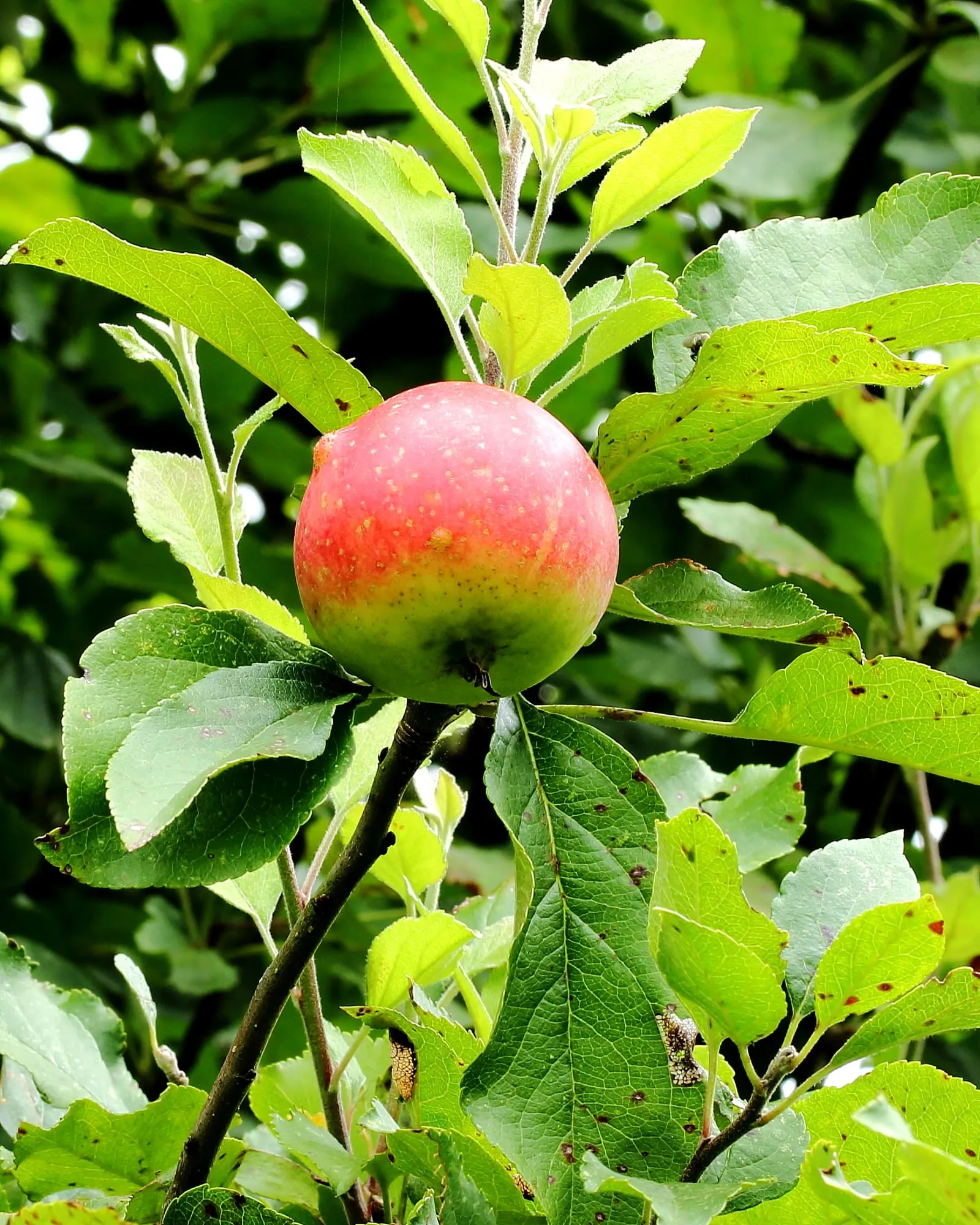
Image: "Malus domestica 'Stark's Earliest'. Locatie De Kruidhof 02", by Dominicus Johannes Bergsma, via Wikimedia Commons, licensed under CC-BY. Source.
