Grafting pair
good compatibilityAnna
on M.26 rootstock
- Compatibility
- Good
- Tree size
- Dwarf
- Mature height
- 8–12 ft
- Crop
- Apple
Compatibility and disease notes
M.26 is fire-blight susceptible. For low-chill warm-zone plantings of Anna, monitor for fire blight in spring.
Overview
Anna is a low-chill apple variety requiring roughly 200 to 300 chill hours, making it one of the few apples that fruits reliably in regions where standard varieties fail to accumulate sufficient dormancy. On M.26, it produces a dwarf tree in the 8 to 12 foot range, suited to high-density plantings and backyard orchards where vertical space is limited and access for pruning and harvest matters. The combination is most commonly planted in the Southeast, Gulf Coast, and Lower Midwest, where warm winters restrict viable apple selection to a short list of low-chill cultivars.
M.26 comes into bearing relatively quickly compared to more vigorous rootstocks, often producing fruit within 2 to 4 years from grafting. This suits growers who want early returns from a compact tree. The trade-off is disease susceptibility: M.26 is known to be fire blight susceptible, and the humid spring conditions common to Anna's primary growing regions are precisely the conditions under which fire blight pressure peaks. Any planting of this combination requires a realistic fire blight management plan from year one. UF/IFAS Low-Chill Apples documents Anna's performance across Florida trial sites and provides useful regional benchmarks for the Gulf Coast and Southeast.
Best regions
Step-by-step grafting guide
The two graft methods best suited to Anna on M.26 are whip-and-tongue (for bench grafting of dormant scionwood onto dormant rootstock liners) and cleft graft (for topworking an established M.26 tree to Anna).
Timing: Graft in late winter to very early spring, when the rootstock is at or just past dormancy break but before active shoot elongation begins. In the Southeast and Gulf Coast, this window typically falls in February or early March. Collect Anna scionwood in late January while it is still fully dormant, and store it refrigerated, wrapped in slightly damp paper, until grafting day.
Tools: sharp grafting knife sterilized with 70% isopropyl alcohol between cuts; grafting tape or budding rubber strips; grafting wax or parafilm; pruning shears for rootstock preparation.
Whip-and-tongue procedure: Make a smooth diagonal cut 1.25 to 1.5 inches long on both rootstock and scion. Cut an interlocking tongue in the center of each diagonal face. Join the pieces so cambium aligns on at least one side, preferably both. Wrap the union tightly with grafting tape, covering the entire cut surface.
Cleft procedure: Cut the rootstock stub cleanly, split the center 1.5 to 2 inches deep, insert two wedge-cut Anna scions on opposite sides of the cleft with the inner cambium of each scion flush to the rootstock cambium. Seal all exposed cut surfaces with grafting wax.
Success criteria: scion budbreak within 4 to 6 weeks; firm, immovable union when gently tested at 8 weeks; no darkening or weeping at the union site. Remove grafting tape before it girdles the growing shoot, typically at 6 to 8 weeks post-graft.
Common failure modes
Fire blight at the graft union: M.26 is susceptible to Erwinia amylovora, and any fresh wound on the rootstock is a potential entry point. If fire blight strikes at or below the union during the first spring, the entire tree is generally a loss. Preventive copper applications at green tip and at petal fall reduce risk but are not a guarantee, particularly in wet springs.
Rootstock suckering: M.26 produces vigorous suckers from below the graft union, especially in the first few years after planting. If not removed promptly, suckers outcompete the Anna scion for photosynthate and can eventually dominate the tree, reverting it to an unproductive rootstock plant. Remove suckers by cutting as close to the root as accessible, not by pulling, which stimulates regrowth.
Late grafting and poor cambium contact: M.26 bark changes in thickness and flexibility quickly as temperatures rise. Grafting after active shoot elongation begins makes precise cambium alignment harder and reduces success rates noticeably. Scion wood that has broken dormancy in storage, showing any swollen buds before the graft is made, performs poorly. If there is no budbreak on the scion by 6 to 8 weeks post-grafting, the union has almost certainly failed.
Sources
Frequently asked questions
- Is Anna apple compatible with M.26 rootstock?
Compatibility is rated good. The union forms reliably when grafting is done at the correct time with proper cambium alignment. The main management concern is not incompatibility but fire blight susceptibility in the rootstock, which requires active monitoring in the warm, humid climates where Anna is most often planted.
- How big will an Anna apple tree on M.26 get?
Expect a mature height of 8 to 12 feet with a similar spread, depending on soil fertility, irrigation, and pruning. M.26 produces dwarf trees that require staking or a trellis for the first several years, as the root system is not strong enough to fully anchor the tree on its own.
- When is the best time to graft Anna on M.26?
Late January through early March in the Southeast and Gulf Coast, depending on when the rootstock breaks dormancy in a given year. Scionwood should be collected and refrigerated in late January while fully dormant. Grafting too late, after active shoot growth begins, significantly reduces success rates.
- Does M.26 require a trellis or support?
Yes. M.26 has a brittle, shallow root system that cannot fully anchor a bearing tree without support. A stake, post-and-wire trellis, or other permanent support structure should be in place at planting, not added later after the tree leans or falls.
- What is the fire blight risk with Anna on M.26?
Elevated compared to fire-blight-resistant rootstocks. M.26 is susceptible, and Anna is typically grown in the Southeast and Gulf Coast where warm, wet spring conditions favor fire blight spread. Preventive copper sprays at green tip and petal fall, along with prompt removal of any blighted wood at least 8 inches below visible symptoms, are the standard management approach.
+−
+−
+−
+−
+−
Related
Related grafts
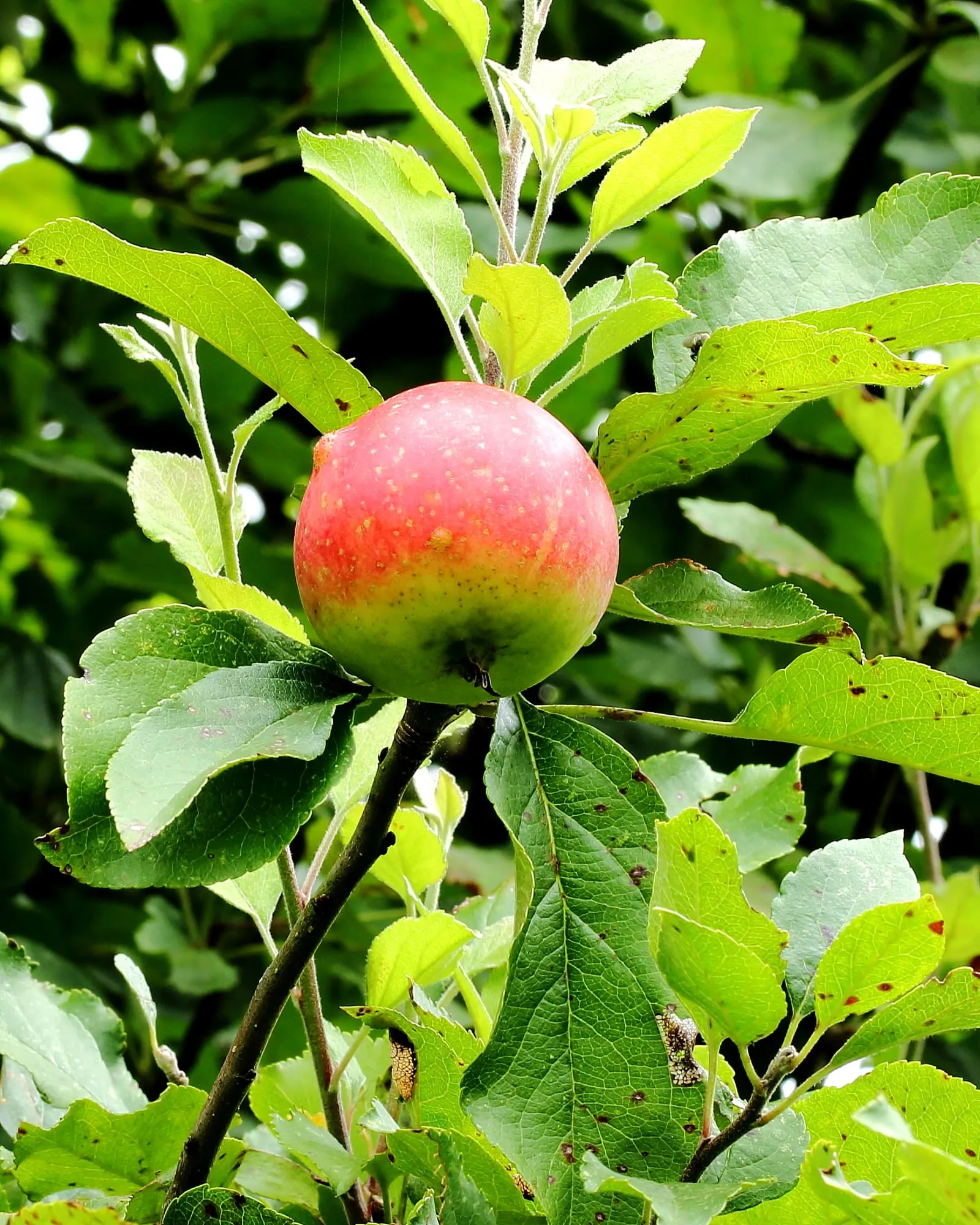
Image: "Malus domestica 'Stark's Earliest'. Locatie De Kruidhof 02", by Dominicus Johannes Bergsma, via Wikimedia Commons, licensed under CC-BY. Source.
