Pest
Persimmon Borer
Sannina uroceriformis
Clearwing moth larvae bore into persimmon trunks at the soil line.
- Scientific name
- Sannina uroceriformis
- Hosts
- 2
- Identification signs
- 3
- Controls
- 4
Biology and lifecycle
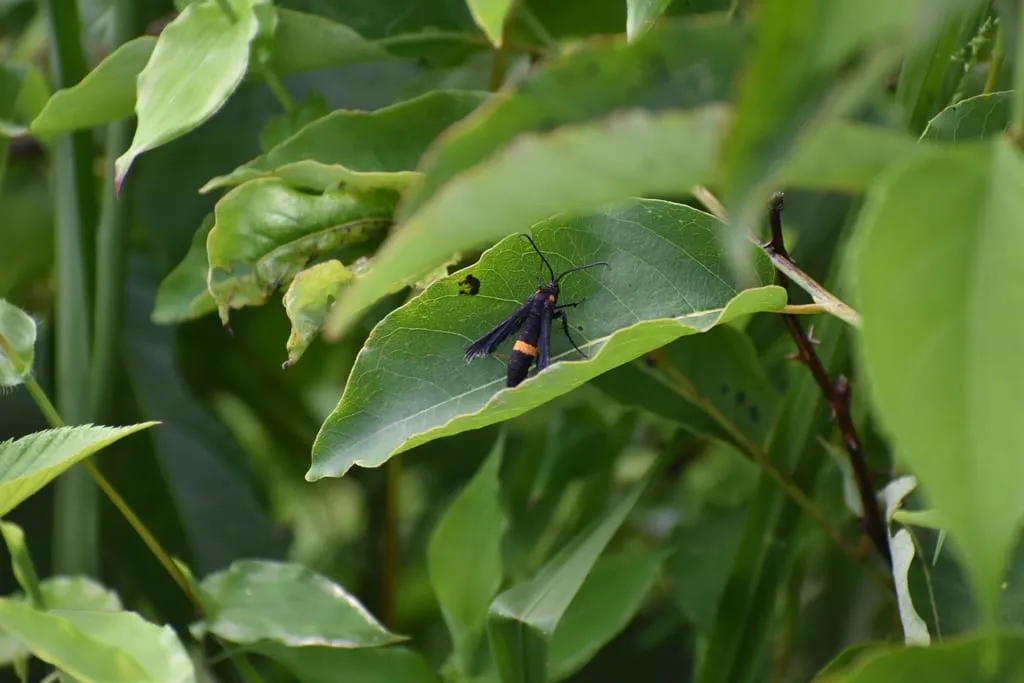
Sannina uroceriformis is a clearwing moth whose adult form mimics a yellowjacket wasp, which likely reduces predation pressure. Adults emerge in mid to late summer, with flight periods running from July through August across most of the persimmon's native and cultivated range. After mating, females lay eggs at or just below the soil line on the trunk. Larvae bore into the crown and root collar tissue, where they feed through autumn and overwinter in their tunnels. Development spans one to two years depending on local temperatures, meaning a single tree can host larvae at multiple life stages simultaneously.
The larval stage is responsible for all meaningful damage. Tunneling through the cambium and crown disrupts water and nutrient movement. Young trees with small-diameter trunks are at higher risk of girdling; established trees accumulate injury across seasons before showing obvious stress. Wilting branches in midsummer and frass accumulating at the soil line are often the first external signs, by which point larvae may already be well-established.
The most cost-effective control window is adult flight, before eggs are laid. Trunk wraps applied at the soil line prior to flight deny females their preferred oviposition site without any chemical input and without disrupting beneficial insects. Pheromone traps can help confirm when adults are active locally, since flight timing shifts by several weeks across latitudes.
For trees with active infestations, physical removal of accessible larvae with a wire or narrow blade is practical and effective when tunnels are shallow. Targeted soil-line sprays timed to peak flight can reduce egg hatch, but applications made after larvae have bored in offer little benefit. Healthy, vigorously growing trees are less attractive to egg-laying adults and better able to limit larval establishment through resin flow.
Signs to watch for
- ▸ Frass at soil line on trunk
- ▸ Wilting branches in summer
- ▸ Larval tunnels visible when trunk is examined
IPM controls
- ✓ Trunk wraps to prevent oviposition
- ✓ Targeted sprays at flight time
- ✓ Prompt physical removal of larvae
- ✓ Healthy tree vigor reduces susceptibility
Affected crops
Image: "Persimmon Borer Moth", by no rights reserved, via iNaturalist, licensed under CC0 Source.
Related