Pest
Root-Knot Nematode
Meloidogyne species
Microscopic soil-dwelling worm that forms galls on roots, reducing vigor and yield.
- Scientific name
- Meloidogyne species
- Hosts
- 16
- Identification signs
- 3
- Controls
- 4
Biology and lifecycle
Root-knot nematodes (Meloidogyne species) are microscopic roundworms that complete their entire life cycle in the soil and root zone. The infective stage is the second-stage juvenile (J2), which hatches from eggs when soil temperatures climb above roughly 50°F and adequate soil moisture is present, typically in spring. J2s migrate through soil water films to reach host roots, penetrate the tissue, and travel to the vascular cylinder, where they establish permanent feeding sites. The plant responds by forming characteristic galls around each feeding site. A single female can produce several hundred eggs, which are enclosed in a gelatinous matrix and remain viable in soil for months.
The period of greatest damage tracks the tree's active growing season. As juveniles multiply and gall formation accumulates, the disrupted vascular tissue reduces uptake of water and nutrients. Above ground, this reads as reduced vigor and summer foliage yellowing even when irrigation looks adequate. Because symptoms develop slowly and below the soil surface, significant root damage can be present long before any visible signal appears.
The highest-leverage control window is before planting. In soils with a documented nematode history, resistant rootstocks are the most reliable option where available. Nemaguard is the established choice for peach in infested ground. For species without a resistant rootstock option, French marigolds as a pre-plant cover crop offer documented suppression. Building soil organic matter supports a diverse microbial community that competes with nematode populations across the season. Fallow rotation reduces viable egg counts substantially but requires taking ground out of production. Post-plant chemical nematicides exist; most are restricted-use materials with meaningful soil ecology costs, making cultural and biological options the practical first line for home orchardists.
Signs to watch for
- ▸ Root galls when soil is excavated
- ▸ Reduced tree vigor
- ▸ Yellowing foliage in summer
IPM controls
- ✓ Resistant rootstocks (Nemaguard for peach)
- ✓ French marigold cover crops
- ✓ Soil organic matter improvement
- ✓ Fallow rotation
Affected crops
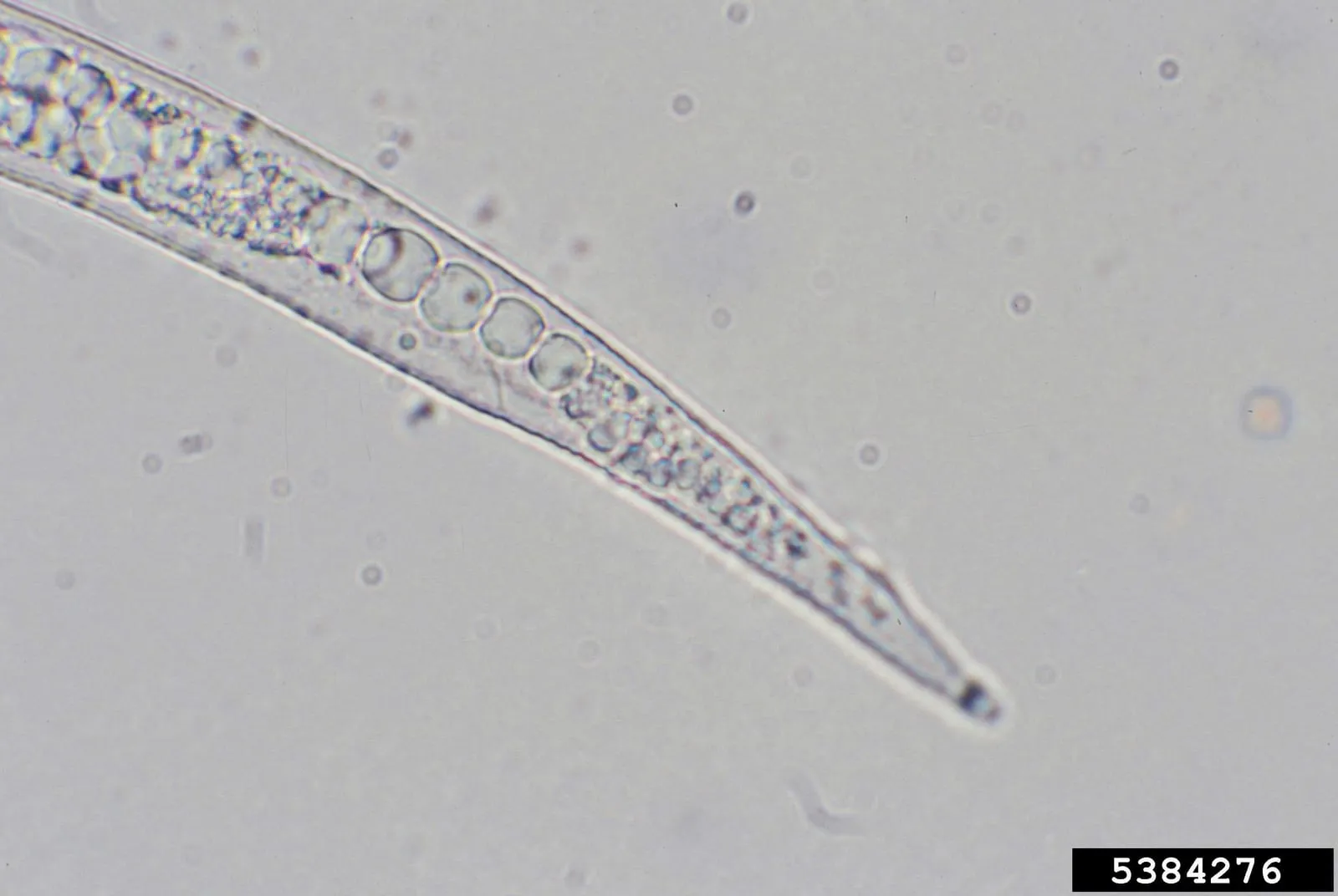
Image: "Meloidogyne incognita adult (01)", by Florida Division of Plant Industry , Florida Department of Agriculture and Consumer Services, Bugwood.org, via Wikimedia Commons, licensed under CC-BY Source.
.jpg)
Related