Pest
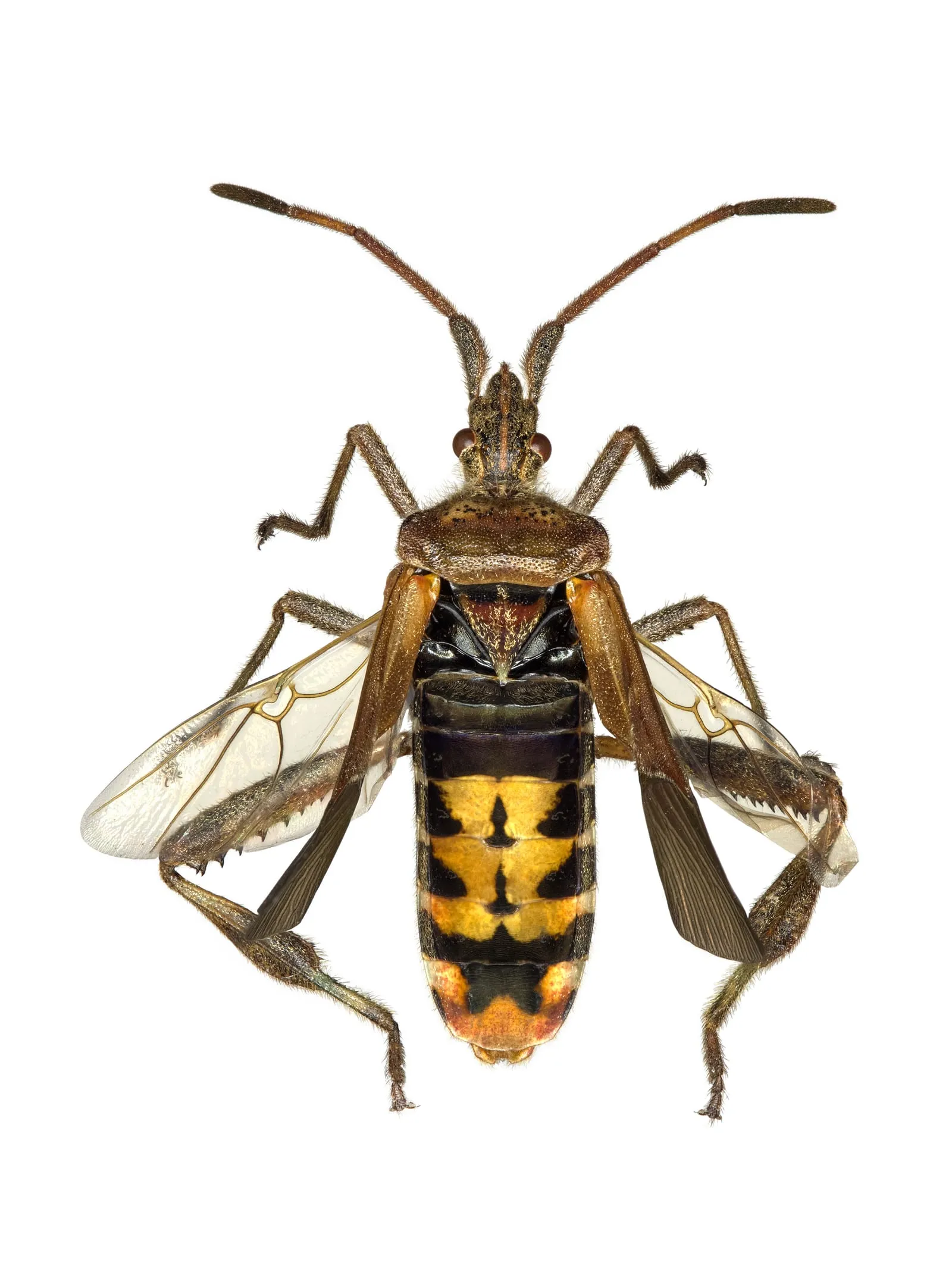
Leaf-Footed Bug
Leptoglossus species
Pomegranate's primary pest in the southwestern US, piercing fruit and causing spoilage.
- Scientific name
- Leptoglossus species
- Hosts
- 1
- Identification signs
- 3
- Controls
- 4
Biology and lifecycle
Leaf-footed bugs (Leptoglossus spp.) are large, conspicuous true bugs recognizable by the flattened, leaf-like expansions on their hind legs. Several species attack pomegranate in the southwestern United States, with L. zonatus and L. clypealis being the most commonly implicated. Adults overwinter in sheltered sites (dense vegetation, woodpiles, building eaves) and become active in spring as temperatures stabilize above roughly 60°F.
Mating and egg-laying begin in late spring. Females deposit neat rows of eggs along stems; nymphs hatch in two to three weeks and pass through five instars before reaching adulthood. The nymph stage is the most damaging window for pomegranate. Immature bugs feed in aggregated groups, and their collective piercing feeding introduces enzymes that cause internal seed darkening and brown sunken lesions on the rind. Fruit pierced during early development is most likely to drop or spoil before harvest; later-season feeding causes cosmetic and flavor defects rather than total loss.
The most cost-effective control window is during the nymph stage, before the population disperses into adults. At that point, physical removal is feasible: adults are sluggish at dawn and can be hand-picked into soapy water. Trap crops, particularly sunflower and sorghum planted at orchard margins, can draw populations away from pomegranate and concentrate them for removal. Encouraging general predator populations (assassin bugs, spiders) provides background suppression. If populations exceed tolerance thresholds, pyrethrin-based sprays applied during peak nymph activity are the lowest-residue chemical option. Broad-spectrum insecticides are generally counterproductive, as they suppress the predator community that keeps populations in check season to season.
Signs to watch for
- ▸ Brown sunken spots on fruit
- ▸ Internal seed darkening
- ▸ Adult bugs aggregating on fruit
IPM controls
- ✓ Trap crops (sunflower, sorghum)
- ✓ Hand-picking adults at dawn
- ✓ Pyrethrin sprays during peak feeding
- ✓ Encouraging predator populations
Affected crops
Image: "Leptoglossus occidentalis-Amerikanische Kiefernwanze-Western conifer seed bug", by ermell, via Wikimedia Commons, licensed under CC-BY Source.

Related