Pest
Japanese Beetle
Popillia japonica
Defoliating beetle introduced to North America in 1916. Skeletonizes leaves of many fruit trees, berry canes, and pecan.
- Scientific name
- Popillia japonica
- Hosts
- 18
- Identification signs
- 3
- Controls
- 4
Biology and lifecycle
Japanese beetle (Popillia japonica) has been expanding its range across eastern North America since its accidental introduction in 1916. The lifecycle runs approximately one year. Adults emerge from the soil beginning in late June across much of zones 5 through 7, with timing shifting earlier in warmer zones and later in cooler ones. Peak flight activity typically runs through July and into August, a window of roughly 4 to 6 weeks when feeding damage is most concentrated.
Adults aggregate in clusters and favor foliage in direct sunlight. They consume leaf tissue between veins, leaving behind a papery skeleton that desiccates quickly. On apples, peaches, plums, and sweet cherries, a large population during peak emergence can strip significant canopy in a short time, reducing photosynthesis and stressing trees before they complete hardening for winter.
The most cost-effective control window is the grub stage, before adults ever emerge. Milky spore (Bacillus popilliae) applied to surrounding turf suppresses local grub populations over multiple seasons. Results build slowly, but the effect persists and does not require annual reapplication. This is the most practical long-term tool where pressure is chronic.
For adult management, hand-picking into soapy water works well at small scale, particularly in early morning when beetles are sluggish. Pheromone traps are counterproductive because they attract more beetles than they capture. Neem oil (azadirachtin) discourages feeding and is appropriate for moderate infestations, especially on bearing trees where minimizing residue matters. Contact sprays such as pyrethrins act faster but break down quickly, require reapplication, and carry meaningful risk to pollinators. If sprays are necessary, apply in early morning or evening when bee activity is lowest.
Signs to watch for
- ▸ Skeletonized leaves with veins remaining
- ▸ Adult beetles in clusters on foliage
- ▸ Reduced photosynthesis from heavy feeding
IPM controls
- ✓ Hand-picking into soapy water
- ✓ Milky spore for grub control in lawn
- ✓ Avoid pheromone traps (attract more)
- ✓ Neem oil for moderate infestations
Affected crops
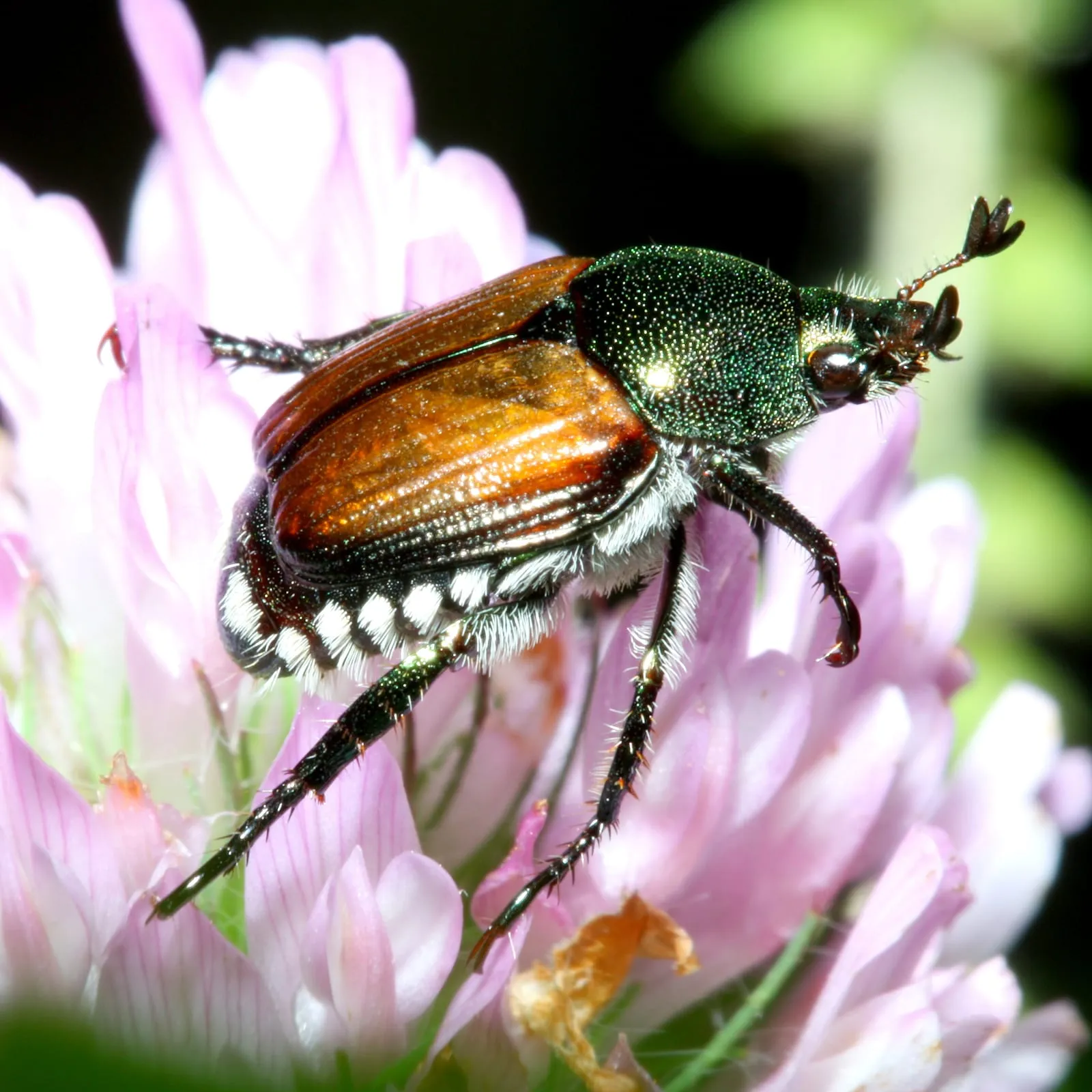
Image: "Popillia japonica", by Bruce Marlin, via Wikimedia Commons, licensed under CC-BY Source.

Related