Disease
fungalCedar Apple Rust
Gymnosporangium juniperi-virginianae
Two-host fungal disease alternating between apple and eastern red cedar. Severe pressure in regions with abundant cedar.
- Pathogen type
- Fungal
- Hosts
- 1
- Symptoms
- 3
- Scientific name
- Gymnosporangium juniperi-virginianae
- Resistant varieties
- 4
Biology and conditions
Cedar Apple Rust (Gymnosporangium juniperi-virginianae) is a fungal disease with an obligate two-host life cycle: it requires both an apple (or crabapple) and an eastern red cedar (Juniperus virginiana) to complete its annual cycle. Neither host alone sustains the pathogen.
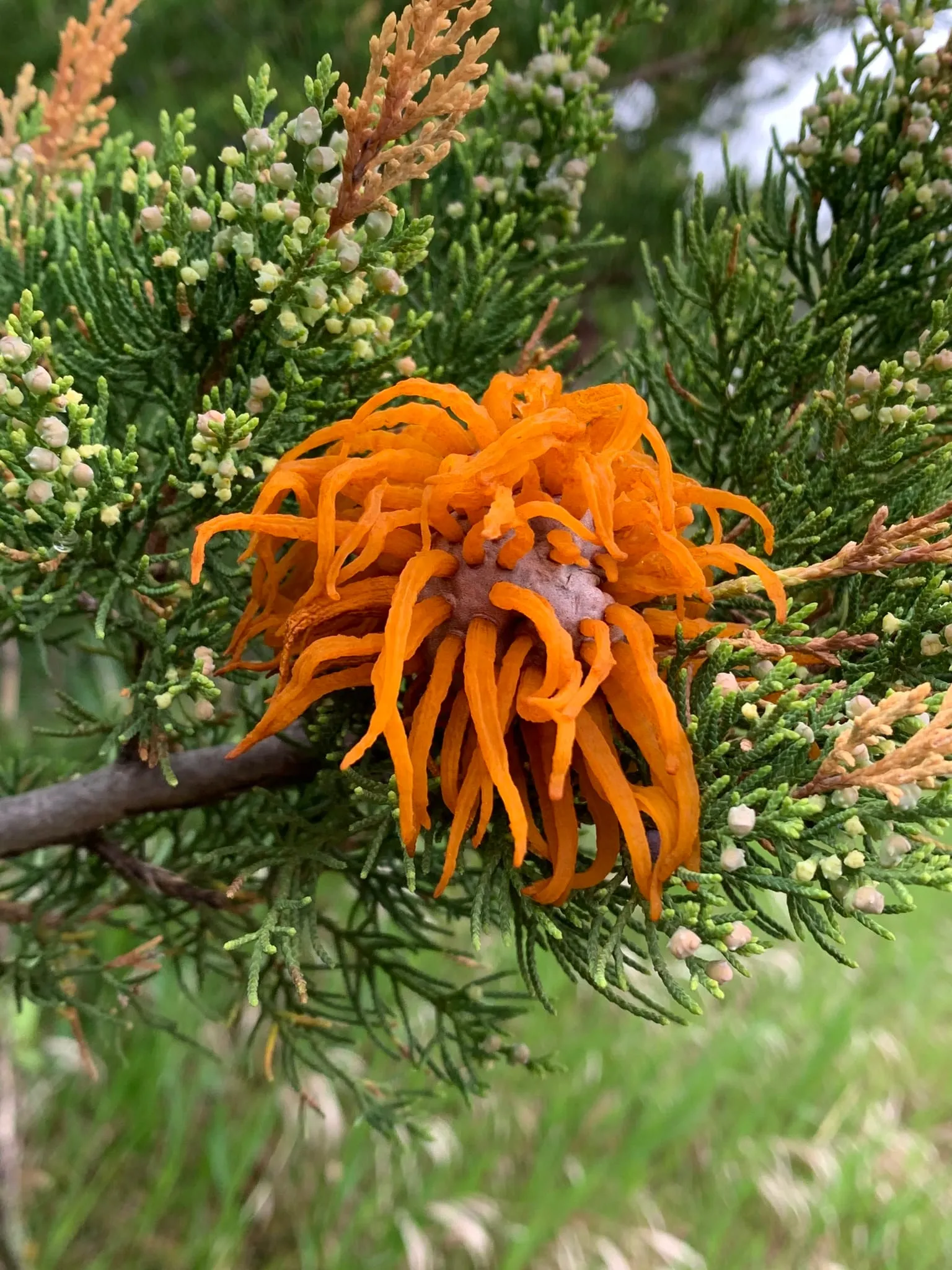
In late winter and early spring, brownish galls on cedar branches absorb moisture and produce conspicuous orange gelatinous horns (teliospores). Wind carries spores to nearby apple trees during and after bloom. On apple tissue, infection shows first as yellow-orange spots on upper leaf surfaces, sometimes progressing to tube-like aecia on the undersides. Severe infections cause premature defoliation, reducing the photosynthetic capacity the tree needs heading into winter. Fruit infections are less common but do occur under heavy pressure.
Conditions that favor significant outbreaks: warm, wet springs during the window from pink bud through second cover, combined with eastern red cedars within roughly 1,000 feet of the planting. The Southeast and Mid-Atlantic see the most consistent pressure given the density of native cedars throughout those regions.
The most cost-effective long-term strategy is variety selection. Liberty, Enterprise, Williams Pride, and Freedom carry strong resistance and rarely require fungicide intervention for rust specifically. For susceptible varieties, protective fungicide applications from pink bud through second cover (roughly a five to six week window) provide reliable suppression when timed correctly. Removing cedars within 1,000 feet eliminates the local spore source entirely, though that is rarely practical in cedar-dense landscapes.
Symptoms
- ▸ Yellow-orange spots on apple leaves
- ▸ Defoliation in severe cases
- ▸ Galls on cedar in spring producing orange gelatinous horns
IPM controls
- ✓ Plant resistant varieties (Liberty, Enterprise, Williams Pride)
- ✓ Remove cedars within 1000 ft if possible
- ✓ Fungicide sprays from pink through second cover
- ✓ Improve air circulation
Resistant varieties
Selecting a variety with documented resistance is the most effective single decision for low-input management of cedar apple rust.
Affected crops
Image: "Gymnosporangium juniperi-virginianae 132338576", by Kathy Fulton, via Wikimedia Commons, licensed under CC0 Source.

Related