Disease
bacterialBacterial Spot
Xanthomonas arboricola pv. pruni
Bacterial disease causing leaf spots and fruit blemishes, severe in warm humid regions.
- Pathogen type
- Bacterial
- Hosts
- 3
- Symptoms
- 3
- Scientific name
- Xanthomonas arboricola pv. pruni
- Resistant varieties
- 2
Biology and conditions
Bacterial spot is caused by Xanthomonas arboricola pv. pruni, a gram-negative bacterium that overwinters in infected buds, bark cankers, and leaf debris from the previous season. In spring, rain splash and wind carry inoculum from these reservoirs to newly expanding tissue. Infection requires free moisture on leaf surfaces and temperatures between roughly 65 and 90°F (18 to 32°C); warm, wet springs in zones 6 through 8 create near-ideal conditions for epidemic spread.
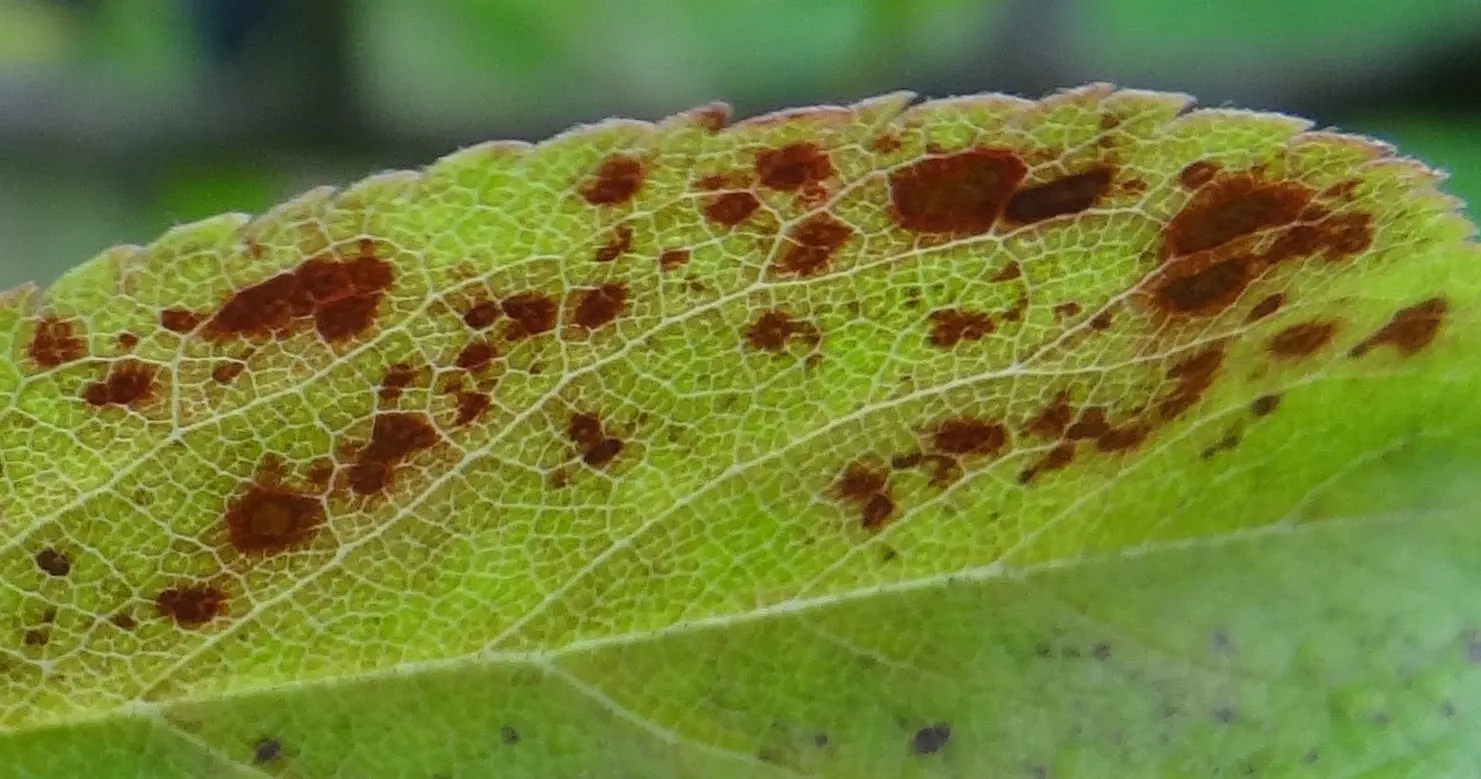
The disease affects peaches, Japanese plums, and apricots. On leaves, early infections appear as water-soaked spots that turn angular and dark as lesions mature. Infected tissue often drops out, leaving characteristic shothole patterns easily confused with other foliar problems. Heavy defoliation weakens trees and reduces fruit size the following season. On fruit, the pathogen causes sunken, pitted lesions that crack under continued wet conditions, opening secondary entry points for rot organisms. Infected fruit is frequently unmarketable even when lesions are shallow.
Management is most cost-effective when it starts at petal fall, before infection pressure builds. Copper bactericides applied at petal fall and through the cover-spray period provide meaningful suppression, though copper resistance has been documented in some Xanthomonas populations; rotating modes of action is advisable where resistance is a local concern. Cultural practices reinforce chemical control: spacing trees for airflow, avoiding overhead irrigation, and removing infected wood during winter all reduce inoculum loads going into the next season. Where bacterial spot recurs annually, variety selection offers the most durable return on effort. Contender and Redhaven peaches carry moderate field resistance and consistently outperform susceptible standard selections in high-pressure environments.
Symptoms
- ▸ Angular dark spots on leaves
- ▸ Leaf yellowing and shotholes
- ▸ Sunken pitted lesions on fruit
IPM controls
- ✓ Plant resistant varieties (Contender peach)
- ✓ Copper sprays at petal fall
- ✓ Avoid overhead irrigation
- ✓ Good drainage and airflow
Resistant varieties
Selecting a variety with documented resistance is the most effective single decision for low-input management of bacterial spot.
Affected crops
Image: "Xanthomonas arboricola pv. pruni WF4", by Jerzy Opioła, via Wikimedia Commons, licensed under CC-BY Source.

Related